

One Distributor or Multiple Suppliers: Which Sourcing Model Fits Your Beauty Business?
One distributor simplifies supplier management; multiple suppliers reduce dependence on one partner. For a beauty business, the better choice depends on brand coverage, per-brand minimums, sourcing checks, and replenishment timing.
This guide compares both models and explains when a hybrid approach can preserve a main supplier relationship while covering gaps.
What Is The Difference Between One Distributor And Multiple Suppliers?
The one distributor model means a beauty buyer sources many brands through a single wholesale partner. The multi-supplier model splits purchases across several brands, distributors or wholesalers. The choice sets how many contracts, invoices, MOQs and authenticity checks a buyer manages.
A hybrid model combines one anchor distributor with a short list of secondary suppliers. Buyers who also compare supply channels can read distributor vs manufacturer.
Why Do Beauty Buyers End Up With Too Many Suppliers To Manage?
Beauty buyers add suppliers one brand at a time, so the vendor list grows faster than the team. Each new supplier brings its own MOQ, price list, payment terms and shipping schedule. The hidden cost shows up in admin hours, not in the unit price.
- Paperwork per order: each supplier sends separate quotes, purchase orders and invoices to reconcile.
- Multiple MOQs: every supplier sets its own minimum, which spreads cash across many commitments.
- Different lead times: separate vendors may fulfill on separate schedules, so one assortment launch can depend on the slowest supplier.
- Counterfeit risk: each new source adds one more chain of custody to verify.
- Freight fragmentation: several small inbound shipments are harder to receive, track and reconcile than one delivery.
How Do The One Distributor And Multi-Supplier Models Compare?
The one distributor model trades some flexibility for simpler purchasing and fewer checks. The multi-supplier model trades simplicity for more options and less dependence on one partner. The table covers the factors beauty buyers raise most often.
| Factor | One distributor model | Multi-supplier model |
| Vendor relationships | One account and one sales contact | One account per supplier |
| Purchase orders and invoices | Fewer, often grouped by brand | A separate set per supplier |
| MOQ exposure | Set by distributor terms, often per brand | One or more minimums per supplier, depending on brand and SKU terms |
| Concentration risk | Higher, since one partner affects many brands | Lower, since risk spreads across vendors |
| Pricing leverage | Volume concentrated with one partner | Competing quotes between vendors |
| Authenticity checks | One partner to vet | Several partners to vet |
| Inbound freight | Potential to coordinate receiving through fewer supplier contacts | More supplier schedules to coordinate |
| Brand coverage | Limited to the distributor’s portfolio | Can reach exclusive or niche brands |
Neither model wins on every row. The right choice depends on brand mix, order size and tolerance for dependency. When comparing individual offers, evaluate beauty supplier quotes using the same product specifications, quantities, and receiving requirements.
When Is The Multi-Supplier Model The Better Choice?
Multiple suppliers can fill gaps when one distributor cannot cover the brands, order timing, or markets a beauty business needs. A backup source is particularly useful when a missed replenishment would interrupt sales of a core product.
- Brand-exclusive lines: some brands sell only direct or through one appointed distributor per territory.
- Fast replenishment: confirm whether stock is available for urgent orders rather than assuming a pre-order product can ship immediately.
- International sale limits: some brands restrict export, so overseas buyers may need an in-market authorized source.
- Critical products: a high-demand SKU that drives repeat purchasing may justify a second verified source.
- Price benchmarking: quotes from two or three suppliers show whether one price list is competitive.
When Does The One Distributor Model Fit A Beauty Business?
The one distributor model fits beauty businesses that carry several brands and spend too much time managing separate suppliers. Wholesalers and retail chains can coordinate a multi-brand assortment, such as the ranges in this cosmetics wholesale guide for the USA, through one sales contact. Each brand may still have its own MOQ and fulfillment schedule.
For example, a beauty business sourcing CeraVe, Aveeno, NYX Professional Makeup, EOS and Palmer’s could manage five brand relationships or work through one distributor. Under QH Distribution‘s purchasing terms, each brand must meet its own MOQ, while the buyer coordinates its requests with one sales team.
- The brand mix spans skincare, bath and body care, and makeup.
- Orders follow a seasonal or quarterly plan, not a weekly one.
- A small team spends too many hours on vendor admin.
- The buyer wants one supplier contact for questions about sourcing and purchasing terms.
Does A Hybrid Sourcing Model Reduce Risk Without Adding Admin?
A hybrid sourcing model uses one anchor distributor for core brands and one or two backups for gaps. The hybrid model keeps most purchasing in one workflow while protecting items that cannot run out. Large companies apply the same logic to their own supply chains.
McKinsey’s Global Supply Chain Leader Survey 2024 surveyed 88 leaders between April 26 and June 10, 2024. Of those respondents, 73% reported progress on dual sourcing and 60% on regionalizing supply chains. The findings illustrate a broader resilience strategy; they are not a beauty-industry forecast or a guarantee that adding suppliers lowers risk.
- Anchor distributor: high-volume, plannable brands ordered on pre-order cycles.
- Backup supplier: a few fast-moving SKUs that need quick replenishment.
- Direct brand accounts: exclusive lines that no distributor offers in your market.
How Does Counterfeit Risk Change The Sourcing Decision?
Each additional supplier creates another business relationship to verify. Fewer verified partners can reduce repeated supplier checks, but supplier count alone does not establish product authenticity. Buyers should still confirm sourcing information and inspect the products received.
- The OECD and EUIPO report Mapping Global Trade in Fakes 2025 valued counterfeit trade at $467 billion in 2021, or 2.3% of global imports.
- The same OECD release lists cosmetics among the hazardous fakes that became more prevalent.
- For beauty buyers, the practical response is to verify the supplier’s identity, ask sourcing questions, and investigate unexplained packaging or product differences before committing to a bulk order. Follow the checks for verifying beauty product authenticity before a bulk order.
Gray-market goods are genuine products sold outside the brand’s intended distribution channel or market. Authenticity, storage condition, and permission to resell in a particular market are separate checks; a genuine product is not automatically suitable for every destination.
How Do MOQs And Cash Flow Work With One Distributor?
One distributor does not always mean one MOQ. A distributor can set minimums per brand, so each brand order must clear its own minimum. The total commitment grows with every brand added.
| Illustrative scenario (4 brands, 30% deposit) | MOQ per brand | Minimum total commitment | Deposit at order |
| All four brands at the low end | $5,000 each | $20,000 | $6,000 |
| Mixed brand MOQs | $5,000, $10,000, $15,000 and $30,000 | $60,000 | $18,000 |
| All four brands at the high end | $30,000 each | $120,000 | $36,000 |
These figures are illustrative, not brand quotations. The mixed-MOQ scenario totals $60,000, with a 30% deposit of $18,000. Confirm the actual minimum for each brand and the payment schedule before deciding how many brands to source together.
How Should Buyers Plan Lead Times In Each Model?
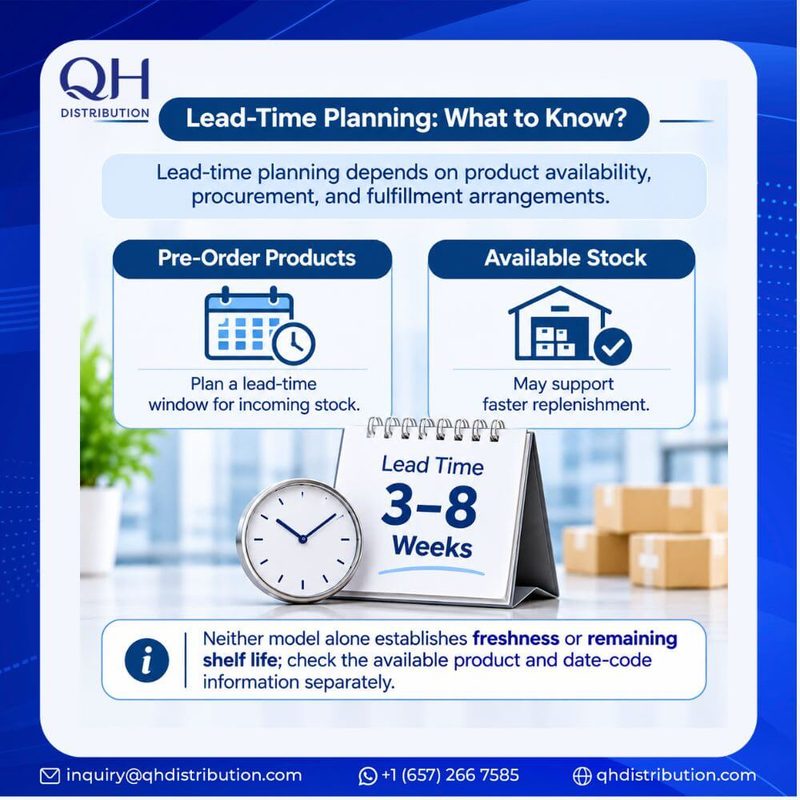
Lead-time planning depends on product availability, procurement, and fulfillment arrangements. Pre-order products need a planning window, while available stock may support faster replenishment. Neither model alone establishes freshness or remaining shelf life; check the available product and date-code information separately.
- Pre-order supply: confirm the expected procurement lead time and the point from which it is measured.
- Order sequencing: place slower brands first so all brands arrive in a similar window.
- Safety stock: hold enough of each fast mover to cover the longest brand lead time.
- Backup source: keep one ready-to-ship supplier for emergency reorders on hero SKUs.
What Market Requirements Should Buyers In Nigeria, The UAE, The UK And The USA Check?
Beauty businesses should check product eligibility, labeling, and any applicable registration or notification requirements in the intended market before ordering. Requirements differ by product category and jurisdiction. The table identifies official systems to check; it is not a complete import-compliance checklist.
| Market | Regulator or system | Requirement to check |
| Nigeria | NAFDAC | Check NAFDAC’s current imported-cosmetics registration and clearance requirements for the intended product and import route. |
| UAE (Dubai) | Dubai Municipality, Montaji / Montaji+ | Confirm the applicable consumer-product registration and importer requirements with Dubai Municipality. |
| UK (Great Britain) | Office for Product Safety and Standards, SCPN portal | Cosmetics placed on the Great Britain market require a UK-established Responsible Person and notification to OPSS before being made available to consumers. |
| USA | FDA under MoCRA | Check whether MoCRA facility registration and product listing apply. Covered facilities renew every two years; responsible persons update listings annually. Exemptions may apply. |
Brand sales permissions and product regulations are separate from receiving arrangements. Confirm the requested brand’s market eligibility with the sales team. In the United States, some personal care products, including certain acne treatments, sunscreens, and antiperspirants, are regulated as drugs or as both drugs and cosmetics.
What Questions Should You Ask Before Consolidating Suppliers?
Buyers should test any consolidation plan against brand coverage, MOQs, lead times and sourcing proof. Asking every supplier the same questions makes quotes comparable. The checklist works for a distributor or a direct brand account.
- Which of my current brands does this supplier carry, and which can ship to my market?
- What is the MOQ per brand, and can brands be combined?
- What is the lead time per brand, and is the product pre-order or warehouse inventory?
- Does the supplier source each brand from the brand, the trusted partners, the manufacturer or an authorized distributor?
- What deposit and payment method does the supplier require?
- What pickup or shipping arrangements are available, and which costs are included in the quotation?
For search methods and supplier channels, see how to find cosmetic distributors.
Summary
One distributor can reduce the number of supplier relationships a business manages. Multiple suppliers can fill gaps in brands, availability, or timing while reducing dependence on one partner. A hybrid approach combines a main distributor with verified alternatives for specific needs.
How Does QH Distribution Fit The One Distributor Model?
QH Distribution is a B2B wholesale distributor of beauty, cosmetics and personal care products with 40+ years of experience. Qualified B2B buyers can explore a portfolio of 290+ brands through one sales team. Confirm the terms for each requested brand before consolidating purchases.
- Brand count: 290+ brands across skincare, makeup and cosmetics, bath and body care, hair care, men’s grooming, and personal care and wellness.
- Sourcing: products come from brands and trusted partners.
- MOQ: $5,000 to $30,000 per brand, with no mixing of brands toward one MOQ.
- Payment schedule: a 30% deposit after order confirmation, with the remaining balance due when the order is ready for pickup or shipping.
- Supply model: Primarily operating on a pre-order basis, with products shipped fresh from brands and trusted partners. We also offer selected stock availability programs. Please contact our Sales Team for more details on current stock offers.
- Lead time: Typically 3 to 8 weeks for pre-orders, depending on brand; confirm timing for the requested order.
- Receiving options: Warehouse Pickup and Shipping Arrangements. Contact the team to discuss options and costs based on your order and receiving requirements.
- Response time: The sales team replies to the wholesale form within approximately 24 hours.
- Customer policy: QH Distribution does not sell to Amazon or other online marketplace resellers.
If your business needs urgent replenishment, contact the sales team to confirm current availability rather than assuming that a pre-order can meet the deadline. Brand and market eligibility also need checking. Full purchasing information is available in the QH Distribution wholesale FAQs.
Ready To Compare One Distributor Against Your Current Supplier List?
QH Distribution is a B2B wholesale distributor of beauty, cosmetics and personal care products. QH Distribution was founded in 1984 and is headquartered in Irvine, California. QH Distribution offers 290+ brands to 320+ customers in 50+ countries. The QH Distribution sales team confirms MOQs, lead times and availability per brand.
Submit the wholesale form and our sales team will respond within 24 hours to assist with your inquiry. QH Distribution does not currently work with Amazon or other online marketplace resellers.
Key Takeaways
- One distributor replaces several vendor relationships with one account, one sales contact and one partner to vet.
- A multi-supplier model spreads risk. McKinsey's 2024 survey of 88 supply chain leaders found 73% reporting progress on dual-sourcing strategies.
- A distributor can set MOQs per brand, so one distributor does not always mean one minimum.
- Pre-order products require advance planning; confirm availability and lead times before relying on a supplier for urgent replenishment.
Frequently Asked Questions
Which types of businesses can buy wholesale from QH Distribution?
QH Distribution works with qualified B2B buyers, including wholesalers and retail chains. Share your business type, sales channels and preferred brands so the team can advise on purchasing eligibility. Beauty brands can also contact the team about distribution and market expansion.
How can buyers discuss pricing and larger orders with QH Distribution?
Submit a wholesale inquiry with your preferred brands and purchasing needs. The sales team can assist with pricing questions and discuss whether a larger order offers savings. Availability and purchasing terms vary by brand.
Which payment methods does QH Distribution accept?
QH Distribution accepts bank transfers and ACH payments. Credit card payments are not accepted. Confirm the payment instructions with the sales team before sending funds.
How does an order start with QH Distribution?
Start by submitting the wholesale form. QH Distribution's sales team will respond within 24 hours to assist with your inquiry and guide you through the ordering process.
How can buyers arrange pickup or shipping with QH Distribution?
Warehouse pickup is available. Contact QH Distribution's team to discuss pickup details or shipping options and costs based on your order and receiving requirements
