

How Do You Build a Seasonal Beauty Inventory Plan?
Seasonal beauty inventory planning matches expected sales with usable stock, dated receipts and a final buying date. Forecast demand for the purchasing window your customers use, then check when each product must arrive and how remaining stock can sell after the peak.
Your customers’ buying cycle sets the calendar. A wholesaler may need products ready for advance orders well before a retail chain needs them for a consumer promotion. Plan around that purchasing window rather than a holiday date alone.
Step 1. Which Products Belong in a Seasonal Inventory Plan?
Group seasonal beauty products by repeat demand, seasonal uplift, event-specific demand or test status. For example, an everyday moisturizer may remain a replenishment item after a promotion, while a holiday beauty gift set needs a defined selling window and a stop-buy decision.
| Product role | Planning approach | Main question |
| Core replenishment | Maintain coverage through the season and afterward | What happens if normal repeat demand continues? |
| Seasonal uplift | Add a measured increase to a repeat-demand line | What evidence supports higher demand in this period? |
| Event-specific assortment | Limit exposure to a defined selling window | How much can sell before relevance declines? |
| New or untested line | Use a cautious test if purchasing terms allow | What evidence would justify expanding the next buy? |
Do not assume skincare, makeup or bath and body products share one universal peak. Geography, customer type, promotion timing and your own sales history determine the pattern to investigate.
Step 2. How Should You Turn Sales History Into a Forecast?
Start with comparable periods of sales history and adjust for changes expected in the next season. A demand forecast estimates likely sales; the inventory plan converts that estimate into quantities, purchasing deadlines, and receiving decisions.
Before copying last season’s figures, review:
- Days when the product was unavailable, because recorded sales then understate what customers might have bought.
- Promotions, price changes and large one-off orders that may not repeat.
- Changes in customer count, trading locations or product range.
- Whether sales occurred before, during or after the event you are planning for.
- Whether a product was new last year and had only a partial selling period.
Create a base case plus plausible lower and higher demand scenarios, and explain which assumptions change. When sourcing multiple beauty brands for one season, track each brand’s minimum order, expected availability, and receiving window separately.
Step 3. How Do You Calculate a Seasonal Beauty Purchase Requirement?
Estimate sales across the window, add the stock you intend to hold at its end, then deduct usable opening stock and confirmed receipts within that window. Also check the timing of receipts before treating them as available supply.
Seasonal purchase requirement = forecast units sold + target ending units − usable opening units − confirmed incoming units.
Illustrative example: one product has baseline demand of 80 units per week over a six-week season. The table adds a 25% seasonal uplift and a 100-unit ending target.
| Input | Illustrative units |
| Baseline demand: 80 units × 6 weeks | 480 |
| Planned seasonal uplift: 25% of baseline | 120 |
| Total forecast sales | 600 |
| Target ending stock | 100 |
| Usable opening stock | 180 |
| Confirmed receipts during the window | 120 |
| Additional purchase requirement | 400 |
For an illustrative six-week season, forecast sales of 600 units plus a 100-unit ending target, less 180 opening units and 120 confirmed incoming units, require 400 additional units. The 25% demand uplift and ending target are planning assumptions, not measured sales.
In a six-week sensitivity check, keep baseline demand at 80 units weekly, ending stock at 100, opening stock at 180 and confirmed receipts at 120. A 10% uplift requires 328 units; a 40% uplift requires 472 units. Both results are illustrative demand scenarios.
Step 4. Can a Seasonal Receipt Arrive After Stock Runs Out?
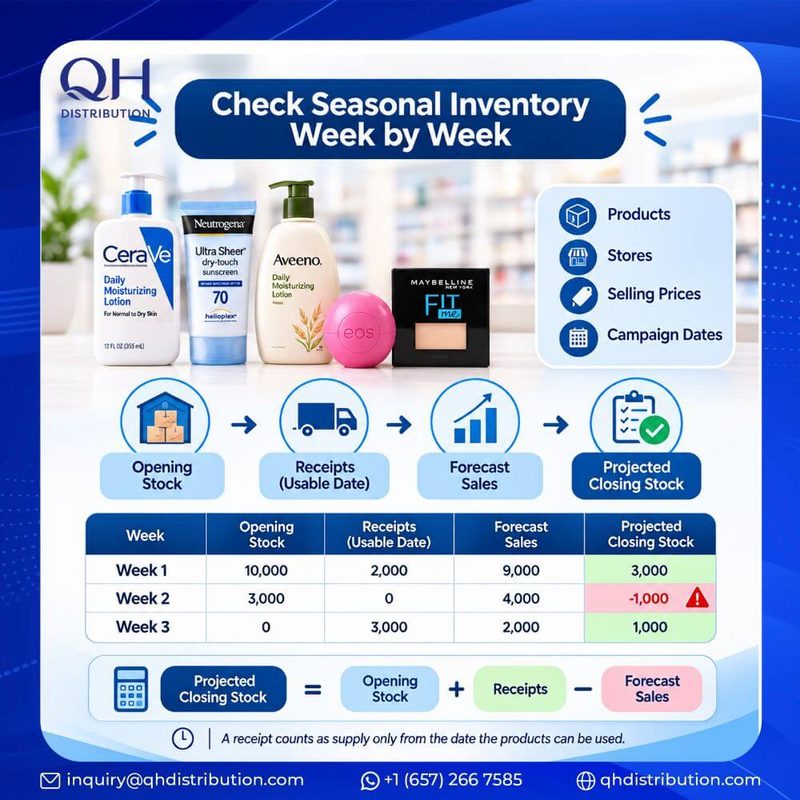
Check seasonal inventory week by week to find stockouts hidden by the total purchase quantity. A weekly stock bridge shows opening units, receipts, forecast sales and projected closing units. A receipt counts as supply only from the date the products can be used.
Projected closing stock = opening stock + receipts − forecast sales.
In an illustrative seasonal plan, opening stock is 180 units and demand is 100 units in each of the first two weeks. A 120-unit receipt arrives in week three. The business is 20 units short before that receipt, even if total seasonal supply looks sufficient.
When a weekly stock bridge shows a shortage, check whether an earlier receipt is feasible. If the timing cannot improve, reduce the affected commitment or change the assortment. Increasing a later receipt does not prevent the earlier stockout.
For core products, the ending-stock target should also account for the next replenishment opportunity. Avoid adding a second reserve for the same risk if that protection is already included in the target.
Step 5. How Do Shelf Life and the Seasonal Selling Window Limit the Buy?
Set the last useful receipt date and decide how remaining products could be sold after the seasonal peak. The MOQ-versus-margin trade-off matters when a lower unit price requires more units than can reasonably sell within the season. Account for cash tied up and product condition before increasing the buy.
Calculate the latest useful buying milestone by working backward from the final receipt date that can still support the season. Subtract confirmed supplier preparation, transport, receiving time and a justified buffer. If that buying milestone has passed, reassess the campaign or existing stock rather than relying on an unconfirmed new receipt.
Cosmetic shelf life depends on the product, its formulation, packaging, storage, and use conditions. Do not apply one remaining-shelf-life assumption to every item; confirm the applicable brand information for the products you plan to buy.
For QH Distribution, shelf-life commitments vary by brand. Ask the team about the applicable terms for preferred brands; do not assume batch details can be supplied before purchase.
Write an exit plan alongside the buy plan: which products continue as core lines, which need a stop-buy decision, and which quantities require a revised commercial plan. An exit plan is your business’s inventory decision, not a promise that a supplier accepts exchanges.
Step 6. What Should You Review While the Season Is Running?
During a season, review actual unit sales, the next shortage date, confirmed receipts and projected ending stock for each product. Category totals can hide a slow line when another product sells strongly. Set a review cadence that leaves time to act on those differences.
Approve a seasonal reorder only when the additional units can arrive within the useful selling window and demand supports the purchase. For a slow-moving line, review future commitments where terms allow; do not raise the forecast simply to justify stock already purchased.
Summary
Seasonal buying needs a forecast, a receipt calendar and a stop-buy date. Check the stock position week by week, and decide how remaining products will fit the business after the peak.
Plan Seasonal Beauty Sourcing With QH Distribution
QH Distribution is a U.S.-headquartered B2B wholesale distributor specializing in branded skincare, cosmetics, and personal care products. Established in 1984, the company brings 40+ years of experience and access to a portfolio of 290+ brands, sourcing authentic products directly from brands and through trusted partners.
Seasonal purchasing depends on realistic brand availability and receiving dates. Share your preferred brands, formats, quantities, intended market, and last useful receipt date with our sales team. QH Distribution primarily operates on a pre-order basis, with occasional in-stock offers during special campaigns; availability and order requirements vary.

Key Takeaways
- Separate repeat-demand products from event-specific inventory before deciding how much to buy.
- Forecast by product and time period, adjusting for stockouts, promotion changes and your own customers' purchasing cycle.
- Check inventory week by week so a receipt arriving late does not hide an earlier shortage.
- Set a final buying date and a post-season plan before committing to seasonal products.
Frequently Asked Questions
How early should I contact QH Distribution about seasonal products?
Contact us early enough to check your preferred brands and compare the relevant lead time with your required receiving window. There is no single advance-order interval suitable for every seasonal plan.
Can I combine different brands to meet a pre-order minimum?
No. Each brand has its own MOQ for pre-orders. We occasionally run mixed-brand campaigns with separate ordering requirements. Please contact our team for details on current offers.
Can QH Distribution confirm the shelf life of seasonal products?
Shelf-life commitments vary by brand. Contact our team for the terms that apply to your preferred brands.
Are stock offers a permanent seasonal replenishment option?
No. QH Distribution occasionally runs in-stock campaigns. Contact our team for current availability and ordering requirements. Future campaigns or inventory offers are not guaranteed.