
How Should You Allocate an Inventory Budget Across Beauty Brands?
Key Takeaways
- Set a demand-based purchasing budget and a separate cash-payment plan; use the tighter constraint.
- Subtract existing commitments before assigning money to new brand orders.
- Keep inventory valuations on one cost basis and include receiving costs in the cash plan.
- Compare additional brands and larger minimums against expected selling time, not just quoted unit prices.
Set a beauty brand inventory budget using the lower of the demand-based buying allowance and available cash for new purchases. Deduct existing commitments first, include receiving costs in the cash plan and check that funds are available on each payment date.
For a business buying several beauty brands, the challenge is deciding how much each range deserves. A repeat-selling line, a complementary range and a new test brand have different demands on the same budget.
How Does a Beauty Buying Budget Differ From Available Cash?
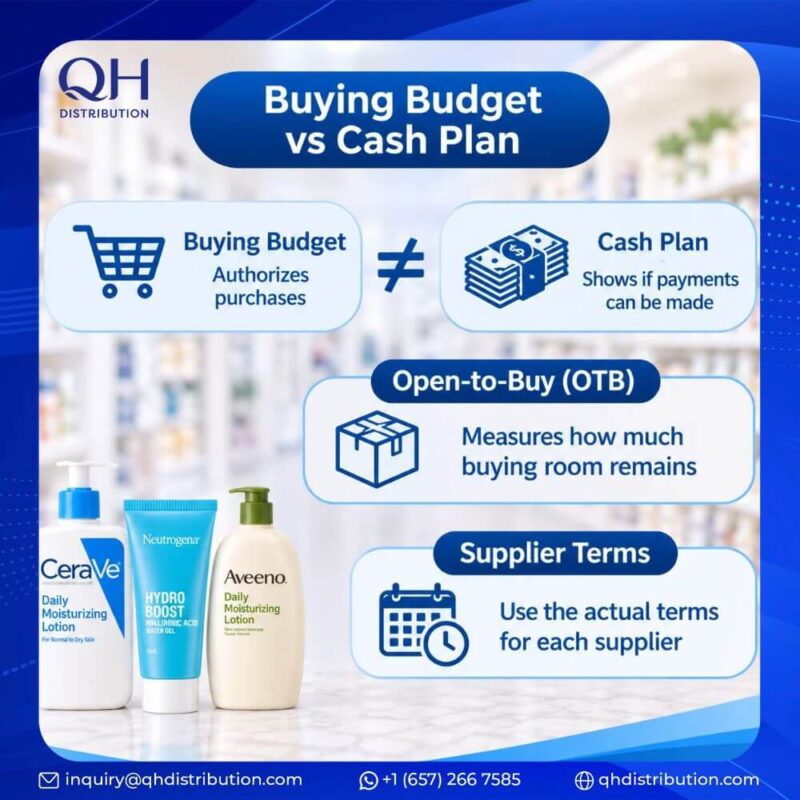
A buying budget authorizes merchandise purchases; a cash plan shows whether payments can be made when they fall due. Inventory that looks affordable over a quarter can still create a shortfall if several obligations occur before expected customer payments arrive.
Open-to-buy (OTB) measures how much merchandise spending room remains after expected sales, planned stock levels, and existing purchase commitments are considered. Calculate its components on a consistent basis—cost or selling value and assess actual cash availability separately.
Use the purchase terms actually applicable to each order. Do not assume every supplier or brand has the same deposit, payment schedule or lead time.
Step 1. How Do You Calculate a Cost-Based Beauty Buying Allowance?
A cost-based beauty buying allowance equals planned cost of goods sold, inventory losses and target ending inventory, less usable opening inventory and existing incoming orders. Use merchandise cost for every amount and include only receipts expected within the planning period.
New merchandise buying allowance = planned cost of goods sold + planned inventory losses at cost + target ending inventory − usable beginning inventory − existing incoming merchandise.
In a cost-based inventory budget, a selling-price markdown affects revenue and margin; it is not automatically a merchandise-cost reduction. Keep the stock values and cost of goods sold on the same basis, using definitions agreed with the finance team.
Illustrative USD budget for one planning period: cost of goods sold is $36,000, target ending merchandise inventory is $24,000, usable opening merchandise inventory is $20,000 and existing incoming orders are $10,000. No inventory losses are planned.
| Cost-based input | Illustrative amount |
| Planned cost of goods sold | $36,000 |
| Target ending merchandise inventory | $24,000 |
| Usable beginning merchandise inventory | $20,000 |
| Existing purchase orders expected in the period | $10,000 |
| New merchandise buying allowance | $30,000 |
The illustrative cost-based buying allowance is $30,000: $36,000 cost of goods sold + $24,000 ending stock − $20,000 opening stock − $10,000 existing incoming orders. The $10,000 receipt is already committed supply and must not be counted again as a new purchase.
Check a cost-based buying allowance against the receipt calendar before approving orders. Products arriving after the sales window cannot support earlier demand, even when the invoice falls within the same accounting period.
Step 2. How Do You Compare a Beauty Buying Allowance With Available Cash?
Cap the new beauty merchandise budget at the lower of the buying allowance and cash capacity. Cash capacity is the funds available after existing payables, receiving costs and the reserve you intend to keep uncommitted. Check payment dates as well as the total.
In an illustrative USD cash plan, a business has $60,000 for inventory after protecting operating needs. Existing merchandise payments take $10,000, estimated transport and receiving take $5,000, and an uncommitted reserve takes $5,000, leaving $40,000 for new merchandise.
| Cash-plan item | Illustrative amount |
| Funds available for the inventory plan | $60,000 |
| Existing merchandise payments due | −$10,000 |
| Estimated transport and receiving costs | −$5,000 |
| Cash reserve kept uncommitted | −$5,000 |
| Cash capacity for new merchandise | $40,000 |
With an illustrative $30,000 demand-based buying allowance and $40,000 cash capacity, the new merchandise budget is $30,000. The unused $10,000 of cash capacity is not in demand for another brand. This comparison assumes the cash is available when each obligation falls due.
A beauty purchasing cash schedule should list each existing and proposed payment by date. Forecast sales are not cash already received. Update cost estimates and purchase terms when confirmed, and record each obligation once so the available balance is not overstated.
Illustrative cash-timing check: a $15,000 payment due next week cannot be covered by only $10,000 available that week, even if another $10,000 is expected next month. Resolve the timing gap before approving the purchase. These amounts explain the decision; they are not QH Distribution payment terms.
Step 3. How Should You Divide a Beauty Inventory Budget Across Brands?
Allocate the budget by each brand’s role, strength of demand evidence, and required purchase commitment. Equal allocations can overfund slower ranges while limiting products with proven demand. Confirm availability and purchasing terms for each selected brand before finalizing the allocation.
For an illustrative $30,000 new merchandise budget, a buyer could allocate $15,000 to a core brand, $10,000 to a complementary brand and $5,000 to a limited test. These are planning caps, not QH Distribution quotations or brand minimums:
| Brand role | Merchandise allocation | Decision basis |
| Established core brand A | $15,000 | Repeat demand and the next replenishment need |
| Established complementary brand B | $10,000 | Demand that adds to the assortment without duplicating the same exposure |
| Limited test brand C | $5,000 | A defined trial with a review date and a maximum commitment |
| Total | $30,000 | Must still fit actual brand and order terms |
In the illustrative $30,000 allocation, the test-brand cap is $5,000. If that brand’s applicable minimum exceeds $5,000, revise the brand choice or trial design. A supplier minimum does not establish customer demand for the larger test; the allocation percentages are not universal recommendations.
Step 4. How Do Brand Minimums and Volume Offers Affect Cash Tied Up in Stock?
A brand minimum can make the purchase commitment larger than the demand forecast. The MOQ-versus-margin trade-off is whether any unit-cost benefit compensates for slower sell-through, extra inventory cash, and shelf-life exposure.
For QH Distribution pre-orders, each brand must meet its own MOQ. Mixed-brand stock offers are a separate occasional option without a separate MOQ for each brand, but other current offer requirements can apply. They should not be treated as a guaranteed way to fill a budget gap.
In an illustrative USD volume offer paid upfront, 1,000 beauty units at $6 landed cost require $6,000; 1,500 units at $5.70 require $8,550. The larger buy lowers unit cost by 5% but ties up $2,550 more cash. At 100 units sold weekly, sell-through time rises from 10 to 15 weeks.
For an upfront-funded beauty order, buying 1,500 units instead of 1,000 at sales of 100 units weekly adds five weeks of sell-through time. Test slower demand and the next replenishment payment against available funds. The illustrative 5.70 landed unit costs are not supplier offers or projected returns.
Step 5. Which Costs Belong in a Beauty Purchasing Decision?
Compare brands using estimated landed cost, including product price, freight, and handling where applicable. To compare beauty supplier quotes fairly, keep charges, quantities, and receiving assumptions consistent and record unresolved amounts separately from confirmed costs.
QH Distribution quotes prices on an EXW basis at the California warehouse. Shipping costs are separate. Contact our team for shipping arrangements and costs so you can include them in your landed-cost estimate.
Shelf life can limit how much stock a budget should support. Product stability varies with formulation, packaging, and storage, so confirm applicable brand terms instead of assuming a universal remaining-life target.
Step 6. How Often Should You Revise the Brand Inventory Budget?
Review when demand, incoming orders, product costs or payment dates change enough to affect the next decision. Compare planned sales at cost with actual cost of goods sold, and update projected ending inventory before releasing more spend.
Keep separate records for budget authorization, orders committed, goods received and payments due. Those figures answer different questions. When a line slows, identify the remaining commitment and revise future buying where terms allow; do not count unsold stock as spend that has already paid for itself.
Summary
Use the lower of the demand-based buying allowance and the cash available for new purchases. Allocate by brand priority, and evaluate a larger order against its extra cash commitment and selling time.
Build a Beauty Brand Budget With QH Distribution
QH Distribution is an Irvine, California-based B2B wholesale distributor founded in 1984. With 40+ years of experience, a portfolio of 290+ brands, and a network of 320+ customers across more than 50 countries, the company connects qualified beauty businesses with authentic cosmetics, skincare, and personal care products sourced directly from brands and through trusted partners.
Start by filling out our wholesale form. Our sales team will guide you through buying options, including each brand’s pre-order MOQ and any current mixed-brand stock offers.
Frequently Asked Questions
Does one budget cover the MOQ for every QH Distribution brand?
No. Each brand has its own MOQ for pre-orders. We occasionally run mixed-brand stock campaigns with separate ordering requirements. Contact our team to ask about current offers.
Are shipping costs included in QH Distribution's prices?
No. Prices are quoted on an EXW basis at the California warehouse. Shipping costs are not included. Contact our team for details on shipping arrangements and applicable costs.
Can a stock offer help me buy several brands within one budget?
Yes. QH Distribution occasionally has mixed-brand stock offers that do not require a separate MOQ for each brand. Contact the team for current combinations and overall requirements before including an offer in your budget.
Will I receive a price list within 24 hours of submitting the wholesale form?
No. Our sales team will respond within 24 hours after you submit the wholesale form and help you with the next steps.