

How Should Beauty Buyers Plan Supplier Lead Times?
Beauty supplier lead time planning works backward from the date your business needs stock ready to sell. Allow for supplier preparation, transport and receiving. Confirm where the supplier’s estimate starts and ends before setting an order deadline.
This guide helps B2B beauty buyers set order deadlines, track different brand schedules and identify replenishment gaps before they affect a launch or seasonal campaign.
What Does a Beauty Supplier’s Lead Time Include?
A beauty supplier’s lead time is the time between an agreed order milestone and an agreed availability or receiving milestone. Confirm both boundaries: an estimate ending at warehouse pickup readiness excludes any transport and preparation your business still needs afterward.
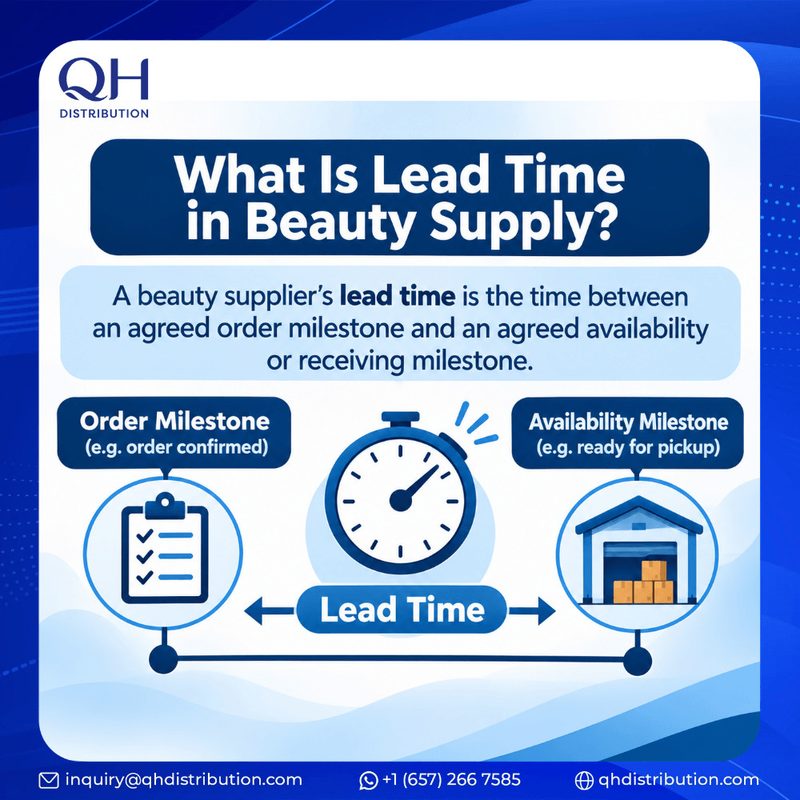
When comparing beauty supplier quotes, use the same starting and ending milestones for every lead-time estimate. A date when goods are ready for pickup is not equivalent to a date when they reach your receiving location. Ask each supplier to specify both milestones in writing.
A beauty purchasing schedule should record each preparation and receiving stage separately:
| Planning stage | Question to resolve |
| Supplier preparation | What triggers the quoted timeframe, and when are products expected to be ready? |
| Pickup or transport | Which receiving arrangement applies, and what time allowance is needed? |
| Receiving | When can your team count, inspect and record the stock? |
| Internal preparation | Is allocation, labelling or another agreed activity needed before use? |
| Schedule buffer | Which uncertainty does the extra time protect against? |
In a purchasing schedule, add durations only for stages that happen sequentially. Where activities overlap, use the actual sequence so the order deadline does not count the same time twice.
How Do You Calculate the Latest Date to Place a Beauty Order?
Start with the date products must be ready for your business, then subtract each non-overlapping stage and a justified buffer. If the quoted lead-time clock starts only after order approval or payment, allow separately for any earlier inquiry and confirmation steps. Use one time basis throughout, and specify calendar days or working days rather than mixing them.
Planning formula: latest order milestone = required ready date − supplier preparation − transport − receiving and internal preparation − schedule buffer.
Illustrative example: a buyer needs the following time allowances before products are ready. These are planning assumptions, not QH Distribution lead times.
| Stage | Illustrative allowance |
| Supplier preparation | 28 days |
| Transport | 10 days |
| Receiving and internal preparation | 3 days |
| Schedule buffer | 7 days |
| Total time before the required ready date | 48 days |
An illustrative schedule with 28 days of supplier preparation, 10 days of transport, 3 days of receiving and a 7-day buffer needs 48 calendar days. The agreed order milestone must occur at least 48 days before stock is needed.
If supplier preparation increases to 35 days while transport, receiving and the buffer remain 10, 3 and 7 days, the illustrative schedule needs 55 calendar days. Order earlier or revise the required date. Choose the buffer around the risks of the actual order.
Why Should You Track Beauty Lead Times by Brand and SKU?
Track each brand order and its important product lines separately because a single purchasing relationship can involve different availability conditions and schedules. A stock-keeping unit (SKU) identifies a specific product variant, such as a size or shade. Keep each SKU’s timing assumptions attached to the relevant brand order.
A brand lead-time tracker should record the product identifier, quantity, agreed timing milestone, estimate, confirmation source and date last checked. Record the intended market and any unresolved product-detail questions beside the relevant brand order.
Mark each tracked date as estimated or confirmed, record when it was last checked, and assign an owner to follow up on unresolved milestones. Keep estimated receipts separate from confirmed supply in event-critical purchasing plans.
For QH Distribution pre-orders, each brand must meet its own minimum order quantity (MOQ). This matters when sourcing multiple beauty brands: buying requirements and readiness dates may differ even when the buyer works with one distributor. Occasional mixed-brand stock offers have separate conditions and should not be treated as guaranteed availability.
When Should a Beauty Reorder Point Trigger Replenishment?
Use expected demand during the replenishment lead time to identify when the next purchasing decision is due. A reorder point is a trigger to review or place a replenishment order under your chosen policy; it does not determine the order quantity by itself.
Reorder point (units) = average daily demand (units/day) × lead time (days) + safety stock (units)
Safety stock accounts for uncertainty. Use a realistic demand forecast to estimate daily demand.
For an illustrative beauty SKU selling 12 units daily, a 35-day replenishment lead time requires 420 units. Adding 60 units of safety stock gives a 480-unit reorder point. The calculation assumes stable demand; use a dated forecast when seasonal demand changes.
When monitoring a reorder point, define how inventory position includes on-hand stock, incoming orders and existing commitments. Also check receipt dates: an incoming order arriving after stock runs out cannot cover the earlier shortage.
What Should You Do When a Beauty Order Will Miss the Required Date?
Revise the assortment, quantity or launch timing as soon as the available schedule falls short. Do not turn an estimated supplier date into a guaranteed arrival to keep a plan looking complete.
- Protect core products by reviewing their requirements before optional additions.
- Ask about current availability and feasible receiving arrangements before assuming a faster option exists.
- Consider products already available within your business when a new receipt cannot support the deadline.
- Recalculate costs and expected demand before accepting a smaller or different assortment.
- Keep unconfirmed inbound lines out of a firm promotional allocation until their timing is resolved.
Shelf-life questions also affect the decision. For QH Distribution, commitments vary by brand, so ask about the terms for your preferred brands instead of building the calendar around a universal minimum remaining shelf life.
Summary
Confirm the boundaries of each lead time, work backward from the required ready date and review the schedule by brand. When a receipt can no longer meet the deadline, revise the purchase or launch plan before committing to it.
Plan Beauty Wholesale Lead Times With QH Distribution
Founded in 1984 and headquartered in Irvine, California, QH Distribution is a B2B wholesale distributor specializing in beauty, cosmetics, skincare, and personal care products. With 40+ years of experience and a portfolio of 290+ brands, the company sources authentic products directly from brands and through trusted partners.
Start by filling out our wholesale form. Our sales team will respond within 24 hours and guide you through the next steps, including availability, lead times and applicable pre-order terms.

Key Takeaways
- Define where a supplier's lead time starts and ends before adding it to your purchasing calendar.
- Work backward from the date products must be ready for use, including transport, receiving and your own preparation time.
- Track availability and timing by brand and product line; one supplier contact does not mean one arrival date.
- Use confirmed dates for event-critical purchases and treat unconfirmed receipts as risks to resolve.
Frequently Asked Questions
Does QH Distribution have one lead time for all beauty orders?
No. Lead time varies with the order and product availability. Contact our team to check the timing for your preferred brands.
Does a response within 24 hours mean my order is confirmed?
No. The 24-hour commitment concerns the sales team's response after you submit the wholesale form. It does not promise a completed quotation, stock confirmation or an order-ready date within that period.
Can I use an in-stock offer for urgent replenishment?
QH Distribution occasionally has in-stock offers during special campaigns. Ask about the current offer, requirements and timing before including it in an urgent replenishment plan.
How should I plan pickup or shipping with QH Distribution?
Contact our team to discuss warehouse pickup or shipping arrangements suited to your order and receiving requirements.
