

How Should Multi-Location Retail Chains Manage Beauty Reorders?
Key Takeaways
- Calculate replenishment needs by SKU and location before making a chain-wide supplier purchase.
- Separate store transfers from new supplier orders and record each incoming quantity once.
- Protect the sending location's needs before moving its apparent surplus elsewhere.
- Use dated stock projections so central inventory does not conceal a shortage at a store.
Manage beauty reorders across multiple locations by calculating each store’s requirement, allocating usable internal stock, and buying only the remaining chain-level need. Keep transfers, supplier receipts, and stock already committed in one coordinated plan so the same requirement is not purchased twice.
A chain can have enough units in total and still run out at the locations where demand is strongest. The purchasing decision must therefore answer two questions: how much additional stock does the network need, and how will usable units reach each store before its shortage date?
What Inventory Records Does a Multi-Location Beauty Chain Need?
Maintain a common product identity across locations, then record stock and demand at each store and distribution center. A stock-keeping unit, or SKU, should refer to the same size, shade, and version wherever the chain holds it.
Use a common reporting cutoff so one store’s morning count is not combined with another store’s end-of-day position without adjustment. Separate usable on-hand units, customer commitments, allocated outbound transfers and confirmed incoming quantities.
| Record | Store-level question | Central planning question |
| Usable stock | What can this store sell now? | Which units remain unallocated? |
| Forecast demand | What will this location need over the coverage period? | What demand is the network buying for? |
| Incoming transfer | When will these units become usable? | Where are the units reserved at origin? |
| Supplier receipt | Is this stock assigned to the store or central pool? | Has the purchase already covered this need? |
| Target ending stock | What should remain at the next planning milestone? | Are reserves duplicated across the network? |
Record each transfer as a linked movement from origin to destination, with dispatch and confirmed usable receipt dates. After dispatch, treat goods in transit separately from the units each location can sell now. A shared transfer reference prevents the same units from appearing as available in both places and makes delayed receipts easier to investigate.
How Do You Calculate a Store’s Beauty Replenishment Requirement?
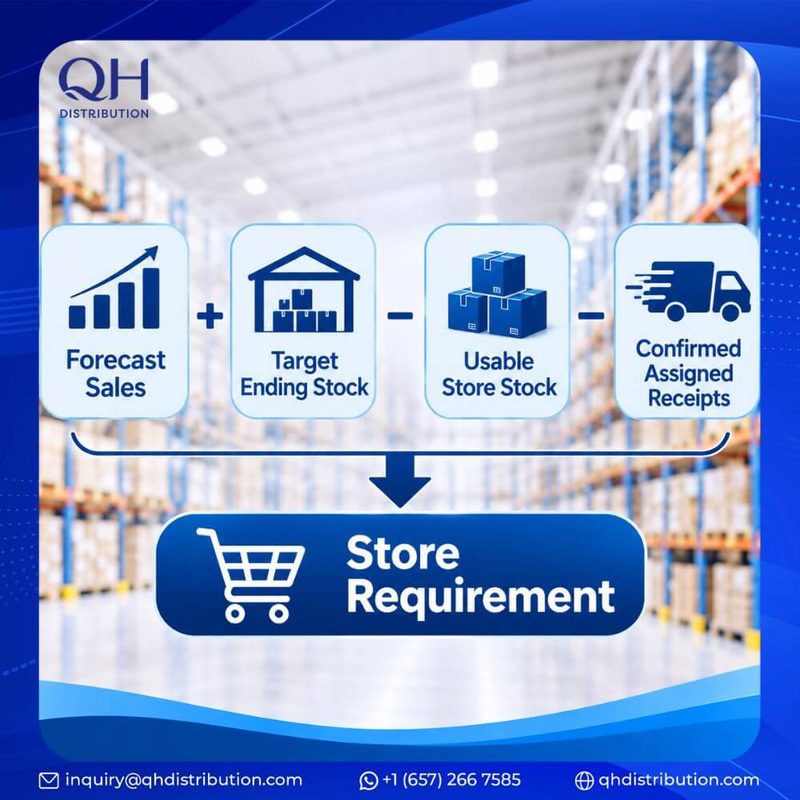
Calculate forecast demand over the chosen coverage period, add the target ending stock, then subtract usable local stock and confirmed receipts assigned to that store. Use a consistent treatment of customer commitments and a zero floor for a proposed transfer requirement.
Store requirement = forecast sales + target ending stock − usable store stock − confirmed assigned receipts.
In an illustrative two-week plan for one beauty SKU, Store A forecasts 90 units, targets 20 ending units, holds 30 usable units, and has 10 incoming units already assigned. Its additional requirement is 90 + 20 − 30 − 10 = 70 units.
Store B’s illustrative two-week forecast is 50 units, its ending target is 15, usable stock is 60, and no receipt is assigned. Its additional requirement is 5 units. Different store demand and opening stock justify different allocations even when both stores carry the same SKU.
Check that the assigned receipt can arrive before the local shortage. The calculation gives a period requirement, while a dated projection identifies whether the store can keep selling until the transfer or supplier stock becomes usable.
How Do Central Allocations Change the Supplier Reorder Quantity?
Deduct the central stock that can genuinely support the store requirements before placing a new supplier order. Keep central commitments and reserves explicit so the same stock is not allocated twice.
In an illustrative two-week plan, Stores A, B and C need 70, 5 and 45 additional units respectively. Their combined need is 120 units. The distribution center holds 100 usable units, of which 20 are reserved for a separate commitment, leaving 80 units for the store plan and a 40-unit external requirement.
| Illustrative location | Additional need | Central allocation | Remaining need |
| Store A | 70 | 50 | 20 |
| Store B | 5 | 5 | 0 |
| Store C | 45 | 25 | 20 |
| Total | 120 | 80 | 40 |
The illustrative allocation of 50, 5 and 25 units is a planning choice, not a recommended universal split. Prioritize using shortage dates, demand, and feasible transfer times. The 40-unit external requirement still needs availability, receipt timing, and purchasing-constraint checks before becoming an order.
If a supplier requires a larger purchase, assess the extra units against demand beyond this window. Do not place the larger quantity automatically or distribute excess equally simply to make store allocations add up to the supplier minimum.
When Should One Store Transfer Beauty Stock to Another?
Transfer stock when the receiving store can use it in time and the sending store remains adequately supplied. An apparent surplus today may already be needed for the sender’s next promotion or replenishment gap.
In an illustrative four-week review, Store D holds 90 usable units, forecasts 40 sales and needs 20 ending units, with no other commitments. It can release 30 units under that plan: 90 − 40 − 20. A request for 45 units exceeds the supported transfer by 15 units and needs another supply decision.
Compare transfer costs with the benefit and verify the remaining selling window. Moving a slow shade from one low-demand store to another changes its location without solving the demand problem. Use actual local demand and product identity, not just a request to reduce the sender’s stock.
Record the sending quantity, dispatch date, destination, and expected usable receipt date. If the transfer is delayed or reduced, both locations’ plans need updating before another buyer treats the missing stock as available.
How Do You Prevent Duplicate Beauty Reorders Across Locations?
Assign ownership of the external supplier purchase and require store requests to reference the central plan. Store teams can identify local needs, but each request needs a status showing whether it is proposed, allocated, dispatched, or already covered by a supplier order.
A store request should close only when its requirement has been met or deliberately revised. A supplier purchase confirmation alone does not mean the destination has received usable stock. Keep the link from request to central allocation, transfer, and receipt.
Use exception checks for:
- A store request covered by both a transfer and a new purchase.
- One central quantity allocated to two locations.
- A transfer shown as usable stock at both origin and destination.
- A cancelled or reduced receipt still included in replenishment calculations.
- Local manual purchases missing from the chain’s central commitments.
Investigate differences before sending another purchase order. Correct records and ownership can remove a duplicate requirement without cutting the stock a store actually needs.
How Should Chains Review Local Shortages and Replenishment Performance?
Review stock risk by date and location, then examine whether the network can act before the shortage. A chain-wide weeks-of-stock figure is too broad to identify every local problem.
Track forecast demand against actual sales, transfer departures against receipts, and shortage days by SKU and store. Record whether the problem began with demand, stock accuracy, central allocation, supplier availability, or internal movement. Those causes require different corrective actions.
Compare performance on consistent definitions. A transfer dispatched on time can still arrive after a store’s required date; a supplier-ready milestone can be met while an internal allocation is late. Keep the stage responsible for the gap visible instead of treating every shortage as a supplier failure.
What Should a Retail Chain Confirm With QH Distribution?
Start by sharing your preferred brands, intended market, and type of business through our wholesale form. Where a chain is purchasing several brands, a multi-brand sourcing plan can keep brand-level availability and purchase commitments separate from the chain’s store allocations. Confirm the supplier receiving arrangement independently of internal transfers and ask about any additional warehouse-service requirements.
QH Distribution primarily operates on a pre-order basis, with each pre-order brand meeting its own MOQ. Occasional mixed-brand stock offers permit multiple brands without a separate MOQ for each brand, subject to the current offer’s other requirements. Neither option establishes an ongoing store-replenishment service.
Contact our team about warehouse pickup, shipping arrangements, and applicable costs. If your chain needs products sent to more than one location, discuss those requirements with us. Your chain manages its own store allocations.
Summary
Replenish each store from a dated SKU-level requirement, use internal stock once and purchase the remaining network need. Protect sending locations during transfers and maintain one owner for the external order so local urgency does not create duplicate buying.
Bring Store-Level Demand Into One Wholesale Purchase
A multi-location reorder becomes easier to manage when the central buyer separates genuine network demand from stock already allocated between stores. As a U.S.-headquartered B2B beauty and personal care wholesale distributor with 40+ years of experience, QH Distribution works with retail chains, wholesalers and other qualified buyers. Your central purchasing team can use a consolidated inquiry to clarify brand requirements while retaining control of store-level stock allocation.
Start with one wholesale inquiry through our form. Our sales team will guide you through product availability, brand MOQ, lead time, and receiving options as the inquiry progresses. Use the confirmed order details in your own plan for allocating stock to stores.
Frequently Asked Questions
Can my retail chain send QH Distribution one consolidated inquiry?
Yes. Fill out our wholesale form with the requested business information. Our team will guide you through the purchasing steps and discuss the order details with you.
Does a QH Distribution order include replenishment to individual stores?
No. Store allocation is part of your chain’s own planning. If you need products sent to different stores or locations, contact our team to discuss the available arrangements.
Can my chain mix brands in a QH Distribution pre-order pallet?
No. Pre-orders are placed by brand and each brand has its own MOQ. We occasionally run mixed-brand stock offers with separate requirements. Contact our team to check current offers.
Can QH Distribution add labels or stickers for our chain?
We supply products in their original brand packaging. If your chain has specific labeling or sticker requirements, contact our team and we’ll check the available options.